


Spirits of Southeast Asia: Indonesia


Indonesia is the world's largest archipelagic state, comprising over 17,000 different islands. As a region, it has a rich history of foreign influences, both as a colonized region and a trading hub. Combined with the rich tapestry of the different tribes, ethnicities, and religious beliefs throughout its many islands, Indonesia probably produces one of the most diverse varieties of spirits in Southeast Asia.
While most of the drinks are palm and rice spirits typical of the region, influences from foreign cultures make these spirits uniquely Indonesian.
Batavia Arrack

Batavia Arrack is a type of rum-like spirit that has its roots in Jakarta, Java. It’s a unique spirit, combining Arabic early distillation knowledge, Chinese fermentation techniques, and the abundance of sugarcane molasses from the Dutch commercialization of sugarcane plantations in the region.
When the Dutch founded a colony in what is modern-day Jakarta in 1619, they named it "Batavia". Earlier Dutch expeditions to the area found that Fujianese/Hokkien immigrants from China had already settled in Java, distilling a form of early arrack spirit made from palm sap and red rice (we surmised that it meant palm sap fermented by rice-based qu).
The Dutch funded Fujianese-owned sugar plantations, handling the export of their sugar and taking a hefty cut in the process. The Fujianese, who were in possession of large quantities of molasses, used it to replace the palm sap they originally used for arrack.
By the mid-17th century, arrack from Batavia was already available in England. The Dutch likely exported it, along with spices from Southeast Asia, to Europe. Having spent several months in teak wood casks (oak doesn’t grow in the tropics) on the ocean voyage to Europe, the arrack arrived as an aged spirit. This distinction, along with its exotic background, made it highly sought-after in London.
Today's Batavia Arrack is made from a base of molasses with a small amount of rice, likely as the fermentation starter. A notable detail of Batavia Arrack is the use of 'hong qu mi' (红曲米), or red yeast rice starter, which is used mainly by the Fujianese to ferment food and rice wine (the red color comes from the mold Mocascus purpureus). Distillation is done in traditional pot stills, but modern column stills have been incorporated in some capacity.
Batavia Arrack is akin to Jamaican rum, with robust and pungent flavors that work well in tropical or tiki-style cocktails, especially in punch recipes with citrus and spices. One example is the 'rack punch', popularized by sailors around London's ports in the 17th and 18th centuries.
Sopi or Ambonese Arrack

Sopi is a type of palm spirit that originated in the Maluku Islands, East Nusa Tenggara. Its name apparently comes from an old Dutch word 'zoopje', meaning 'a little drink' or 'liquid alcohol'.
Most Sopis are produced by families who own palm plantations. Sopi is also made in Flores, where ethnic groups such as the Manggarai people traditionally consume it during festivities and rituals. The name 'Ambonese Arrack' is less common, referring to the island of Ambon, which was the Dutch East India Company's headquarters before Batavia.
The drink replaced traditional palm wine as a staple in celebrations and rituals, and is commonly used to mitigate conflicts between different parties. In some cases, Sopi were used as medicinal tincture. In Tanimbar, Maluku, a tradition exists where cash is plugged into a Sopi bottle's opening and presented as a form of payment to validate the sale of an important asset, such as land.
To produce Sopi, the sap from the palm tree is collected and left to ferment for a day. The specific palm tree species varies between islands, with coconut (Cocos nucifera), palmyra palm (Borassus flabellifer), and sugar palm (Arenga pinnata) being the most common. Depending on the island, herbs such as husor root (Garcinia picrorhiza) and lancium root (Lansium domesticum) are added to prevent the sap from turning into vinegar during fermentation.
As Sopi is mostly produced on a small scale and never commercialized, there are various methods of distillation. Villages closer to cities may see iron barrels fashioned into distillation devices, while rural communities may utilize clay pots and bamboo stills. Most Sopi are distilled using wood fire, and usually come off the stills at 30-60% ABV.
Ciu Banyumas
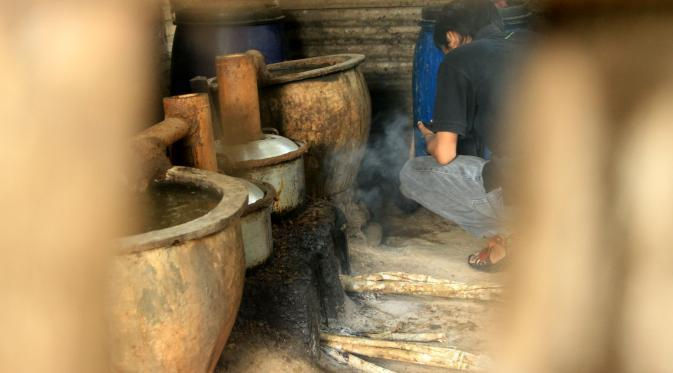
There are two variations of Ciu in Central Java, Indonesia. The first originates in Banyumas, while the other is made in Bekonang, Surakarta. Ciu Banyumas is made from cassava roots, with jaggery added to increase the alcohol content.
The word 'Ciu' is a transliteration of chiú' (酒), or "alcohol" in the Fujianese Hokkien dialect, pointing to its Chinese influence. The Chinese established a trading presence in Java as early as the 15th century, predating both Portuguese and Dutch in the region.
Although well-known in Java, production of Ciu Banyumas is an illicit cottage industry, often made by homemakers and sold to regular customers. Production is very secretive, as distillers fear being caught by the authorities.
To make Ciu Banyumas, cassava roots are cooked and mashed. Once cooled, the mash is mixed with jaggery, water, and 'omplong', which is the leftover mash from the previous batch that will act as the fermentation agent. The idea is similar to sour mash in American whiskey or rum dunder in Jamaican rum. Every family has their own omplong, which contributes to the unique flavor and consistency of each batch. The fermentation process takes up to a week and is constantly stirred to ensure even fermentation.
Most Ciu Banyumas are distilled by boiling the fermented mash in iron pots. Bamboo poles on the pot cover serve as a channel to collect the evaporated alcohol. These pots are wood-fired, though some Ciu makers use gas stoves. Some Ciu are double-distilled, pushing the alcohol content up to 70% ABV.
Ciu Banyumas are often served in small glasses and enjoyed during gatherings. Within Banyumas, production is centered around the Wangon district, with Cikakak village, Windunegara village, and Wlahar village forming the Golden Triangle. Due to its illicit status, Ciu is hardly found outside of Banyumas.
Ciu Bekonang

Ciu Bekonang, or Ciu Solo (after the colloquial name of Surakarta city), is made from sugarcane molasses. Much like Ciu Banyumas, Ciu Bekonang originated as a fermented cassava spirit, produced within an illicit cottage industry. The shift to molasses came after the establishment of the Tasikmadu sugar factory (Pabrik Gula Tasikmadu) in 1871 – it’s still in operation today – while the region was under Dutch control.
The factory’s molasses, a byproduct of sugarcane refining, were collected by locals who fermented and then distilled it into Ciu. Today, local producers collect molasses from sugar factories all over Java. In essence, Ciu Bekonang is similar to rum, but often sold at only 25-35% ABV.
To make Ciu Bekonang, molasses are left to ferment in big plastic barrels for a week. Distillation is done in modified steel barrels, and some producers add fruits, such as melons and pineapples, to create flavored Ciu.
Since Ciu Bekonang is cheap, it’s popular among young adults and laborers. Since the culture of drinking Ciu is deeply ingrained in the area, plus the fact that its production is an additional source of income for locals, law enforcement is difficult.
To mitigate this, local authorities have encouraged Ciu producers to distill their alcohol to a higher concentration (70-90% ABV) to sell as medical and industrial alcohol.
Balinese Arrack or Arak Bali
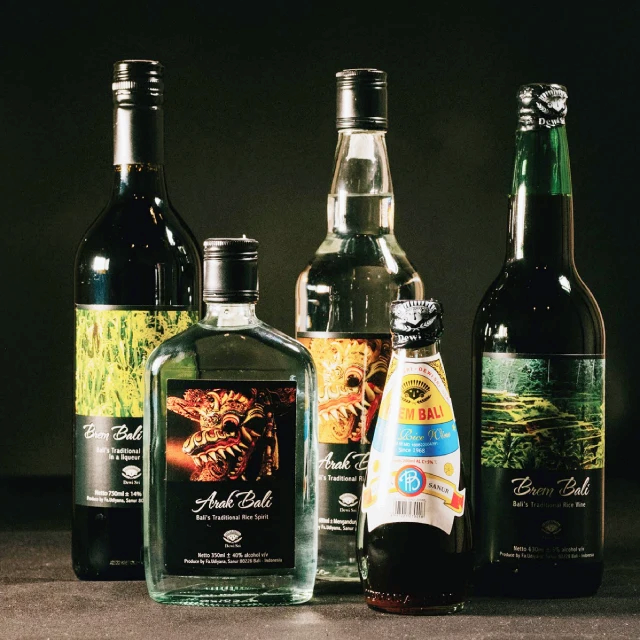
Balinese Arrack refers to a group of traditional spirits from Bali, usually made from palm sap and glutinous rice. Balinese Arrack is legally produced and regulated by the government, since it was listed as one of Indonesia's Intangible Cultural Heritages in 2021.
Traditional Balinese Arrack is made from the sap of either coconut, sugar (aren) palm, or palmyra palm. The sap is collected before dawn and left to ferment for several days. Distillation takes place in either stainless steel or copper stills, replacing the traditional clay pot stills.
While less common, rice Balinese Arrack also exists. Derived from a local rice wine called brem, rice arrack is made using white and/or black glutinous rice. The steamed rice is inoculated with a local rice yeast cake called ragi tape, before being left to ferment for two weeks. After distillation, the rice arrack produces a soft rice aroma and flavor.
A small group of producers also use salak fruit to make the arrack. Salak, or snake fruit, is grown in Karangasem regency in eastern Bali, an area with a unique variety of salak not found anywhere else in the world. To make salak arrack, the fruit is fermented for several days before being distilled; the spirit has a mild honey and white fruit (rambutan and longan) sweetness.
Balinese Arrack can also be infused with fruits and spices from the region, including botanicals such as ginger, turmeric, cinnamon, cloves, and vanilla. A popular infusion is with coffee beans, usually from the Balinese highlands (ie. Kintamani district). Bali’s rich volcanic soil is beneficial to the island's agriculture, and arrack producers reflect that in their spirits.
Today, Balinese Arrack is still an important part of Bali’s Hindu culture, serving as offering to deities during rituals. It’s also used in cleansing rituals in homes or offices, and imbibed during festivities.
Tuo Nifaro
Off the western coast of Sumatra is the Nias archipelago, where a version of palm spirit is similar yet distinct from Sopi. The difference lies in a rare practice: the cutting of the head of the distillate.
Like all Indonesian palm spirits, sap from either coconut or sugar palm is used. The sap, or nira, is collected before dawn and left to ferment naturally in bamboo containers. If the sap was meant for palm wine, laru roots are added to the fermentation to prevent the sap from turning into vinegar. The finished palm wine, known as Tuo Mbanua among the Nias people, contains about 10% ABV. Palm sap intended for Tuo Nifaro is fermented without the addition of roots, resulting in a palm wine of about 5% ABV.
The distillation of palm wine for Tuo Nifaro is done in small batches of around 20 liters. It’s heated over a slow fire for approximately 6 hours in a pot still made from either iron drums or clay pots. The first batch of the distillate, known as Hogo Duo (meaning 'first bottle'), contains spirits up to 90% ABV. In other parts of Southeast Asia, this part is usually mixed with spirits of lower alcohol to maximize the yield. For the Nias, the distillate is mixed with medicinal herbs to make ointments. The latter part of the distillate will be bottled as Tua Nifaro, with an alcohol content of 35% to 50% ABV.
Much like Sopi and Ciu, Tuo Nifaro is officially illegal to produce, but it persists as part of the culture of Nias. Although the majority of the population are Christians (over 80% Protestants), cultural practices related to ancestor worship still exist. During festivities and ritual, Tuo Nifaro is served to important guests and presented as offerings to ancestors or deities.
Special Mention: Cap Tikus

Cap Tikus is a type of Sopi made by the Minahasa people of North Sulawesi, and became synonymous with the palm spirits through brand recognition.
The name translates to 'rat brand' and is believed to have originated in the 1820s, right before the Java War (1825-1830). The story goes that the Minahasa warriors, who were preparing for war alongside the Dutch, encountered Chinese merchants selling Sopi at Fort Amsterdam (Ambon Island, Maluku). The drinks were sold in blue bottles, with a label depicting a rat. The warriors apparently enjoyed the drink so much that they sought out the rat label. Over time, 'Cap Tikus' became synonymous with high-quality palm spirits, replacing 'Sopi' as the word for palm spirit among the Minahasa.
Unlike Sopi, Cap Tikus is legally produced and highly regulated. The brand Cap Tikus 1978 was launched in 2018 and is one of the first modernized palm spirits of North Sulawesi, using local palm sap as its base.


