


Spirits of Southeast Asia: Myanmar


When we talk about Myanmar's alcoholic drinks, beer and rum always take the spotlight, as they were introduced to the country by the British in the 19th century. However, hidden in mountains and valleys beyond the cities, you’ll find traditional spirits whose origins have long faded from record. Rarely commercialized, they persist in small isolated pockets where one must travel off the beaten path for a chance to have a tipple of it.
Palm Drinks: Htan Yay and Htan A Yet
Nestled in Upper Myanmar is an area known as 'Anyar' or the Central Dry Zone. This semi-arid region is home to approximately 80% of Myanmar's population, mostly employed in the agricultural sector. Sheltered from the southwestern monsoon by the Arakan Mountains, Anyar experiences sparse rainfall. Despite these circumstances, centuries of development in water irrigation systems dating back to the Pagan Kingdom in the 9th century have made the region the agricultural heart of Myanmar.
Within Anyar, paddy, corn, and wheat make up the bulk of the grain produced. Oilseed plants such as sesame and peanuts are also commonly grown. However, when it comes to making traditional liquor, toddy palm is the preferred base.
On the outskirts of Bagan along the Irrawaddy River, one can find toddy palm (Borassus flabellifer) plantations along the dusty road leading into town. Mostly family-owned, these plantations produce both jaggery and a local palm wine called Htan Yay (ထန်းရည်), meaning 'palm juice' or 'palm water'. It is also called 'Sky Beer', a nod to the height at which the toddy tapper climbs to collect the sap.
To produce Htan Yay, toddy tappers climb trees up to 50m tall to collect palm sap from the flowering stem into clay pots. Fermentation begins almost immediately, and by day’s end, the liquid can turn to vinegar.
Although Htan Yay can be drunk as is, some tappers use palm sap to produce a spirit known as Htan A Yet (ထန်းအရက်) – meaning 'palm arrack' or 'palm liquor' – which is sometimes (erroneously) referred to as 'palm wine' by foreigners.
While other Asian palm spirits like Ceylon Arrack (Sri Lanka) or Lambanog (the Philippines) are distilled from fermented palm sap or palm wine, Htan A Yet is distilled from palm jaggery. Unlike the sap, palm jaggery does not ferment on its own, so Htan A Yet makers add rice yeast made from glutinous rice for fermentation.
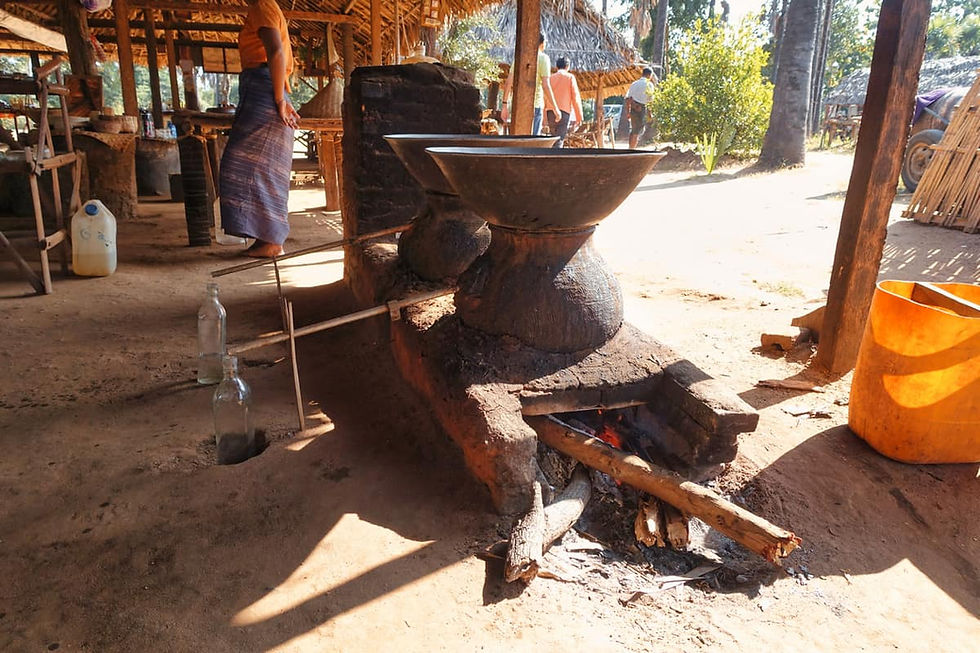
To make Htan A Yet, palm jaggery is first cooked down into a syrup, then combined with crushed glutinous rice yeast and water to initiate fermentation. After about a week, the fermented mixture is transferred into a large clay pot set over a wood-fired earthen stove for distillation. A second pot filled with cold water is placed on top, acting as a condenser that cools the rising alcohol vapor. The condensed liquid is collected in a pan beneath the upper pot and channeled through a pipe into a bottle. Distilled once, Htan A Yet can reach an alcohol content of around 50% ABV.
Htan A Yet is described as a slightly sweet and sharp spirit, similar to white rum. Sometimes, it can be infused with regional herbs and used as an ointment in folk medicines. Htan A Yet is rarely found outside of Mandalay, as it is often more labour-intensive to produce than Htan Yay.
Ethnic Brews: Khaung Yay and A Yet
Besides the Central Dry Zone, Myanmar's mountain ranges are home to diverse ethnic groups and, by extension, their brews. These groups live off the mountains' resources, farming rice and fruits for sustenance and trade. They have also developed alcoholic brews made from rice and rice yeast. Although each group has its own name for it, Khaung Yay (ခေါင်ရည်) – which roughly translates to 'sweet wine' – is the catchall term for rice-based brews made by different ethnic groups.
In general, most are fermented from (glutinous) rice, though there are exceptions. The rice wine of Khaung Yay is traditionally served with the rice lees and sipped from a small clay jar using a bamboo straw. Other styles of wine are usually filtered, though they may be cloudy. Khaung Yay is made by several ethnic groups, with notable ones being the Chin, Kachin, and Kayah.
The Chin tribe's Khaung Yay is predominantly rice wine, though the term also refers to wine made from rhododendron flowers and fruits, such as apples and hawthorns. In their local Mizo dialect, rice wine is called 'Zûpui', which uses Chinese qu as the fermentation starter due to its effectiveness and high alcohol yield. Khaung Yay is often consumed during celebrations and festivities, like the Chin National Day (February 20th).
The Kayah tribe's Khaung Yay is brewed from staple grains, since most tribe members farm crops like rice, corn, millet, sesame, and groundnuts. Their Khaung Yay is usually made from glutinous rice, though millet and corn are also used. The Kayah enjoy their Khaung Yay over a meal, typically paired with meats like Kayah pork sausage.

The Kachin tribe's Khaung Yay is known as 'Sapi' in the Kachin language. Made mainly from glutinous rice or millet, the Khaung Yay is left to ferment in large clay jars for up to a month, sometimes longer. The finished brew is traditionally served unfiltered with rice lees, and is a staple during celebrations, symbolizing hospitality and community unity.
Although uncommon, some Khaung Yay makers distil their brews into spirits known as A Yet (အရက်). This practice is especially common among the Kachin in small quantities using rudimentary equipment. Pot stills constructed from metal, earthen pots with bamboo channels or wood are all used in the distillation of A Yet, based on the material's availability. The stills are heated using firewood, which impart a slight smoky aftertaste in the A Yet.
Besides festivals, ethnic groups also consume A Yet as medicinal tonics. Much like Western herbal liqueurs, A Yet's alcohol concentration (30-50%) allows for the infusion of beneficial herbs and spices such as caraway, chilli, and ginger. Medicinal A Yet is sometimes sweetened with sugar or honey.
Tribes from Shan State (eastern Myanmar) also produce their own A Yet, which is often erroneously labeled as 'rice whisky', as it is distilled from the fermented mash of broken rice and rice husks. The fermentation process takes up to three months before distillation, resulting in a drink with a mild rice aroma and a potent kick.
The Chin tribe also produces A Yet, known in the Mizo dialect as 'Zû', which uses husked rice as the base that is fermented with rice yeast and distilled. The drink holds a significant role in their animistic practice, despite the majority of the ethnic group's conversion to Christianity. Zû is often produced for communal consumption and rituals (commonly offered to deities and the deceased during religious rituals) and never commercialized.


