


Spirits of Southeast Asia: The Philippines

Updated: 3 days ago

The Philippines is the home to some of the most diverse categories of alcoholic brew in Southeast Asia, partially due to the variety of cultures and people that inhabit the different islands of the country.
Here, we can find rice wine typical of the region, known locally as tapuy (or tapuey). Besides that, there is also basi, a type of sugarcane wine. One can also explore a unique brew named agkud here, a rice wine that is fermented alongside sugarcane juice and flavoured with ginger or hot pepper. Then, there are brews like pangasi, which are made either from rice, millet, job's tears or cassava. To make matters complicated, pangasi can also be made with corn or sorghum instead of rice.
Beyond these traditional brews, the country is also home to the first Western beer brewery in Southeast Asia, which was established in 1890.
Being a nation of island archipelagos, the palm is an integral part of the daily life of Filipinos. Coconut milk and palm jaggery made from the kaong palm (Arenga pinnata) are staples in Filipino cuisine. As such, it should come as no surprise that palm wine is probably one of the most popular brews of the country (besides beer). Known locally as tuba, the Filipino palm wine is the precursor to the spirit that we will be focusing on in this article.
Tuba

The tuba is deeply ingrained in Filipino traditions and culture. When the Spanish arrived in the region in the 16th century, they noted the widespread consumption of palm wine in the Filipinos' daily life and rituals. During pre-colonial times, it was often used as an offering by shamans to initiate communication with the spirit world. The drink is also a common sight at festivals and celebrations, as it symbolizes camaraderie, hospitality, and festivity as a whole.
To make tuba, the tuba maker will first collect the sap from palm trees. In the Philippines, the specific palm tree species varies between the islands. While coconut is common, tuba made from nipa palm (Nypa fruticans) and kaong palm are also available. The method varied slightly between palm species, but generally, the sap is harvested from the cut flowering stalk of the palm.
The sap can be consumed as is and is known as tuba dulce due to its sweetness. If not consumed, the sap will start fermentation immediately. The fermentation lasts no more than a day, as sap fermented longer than that will turn into palm vinegar instead. Most tubas are sweet with a hint of sourness.
A notable mention is the bahalina, often referred to as 'coconut red wine'. Bahalina is an aged tuba, made possible by adding the bark of certain mangrove trees. The bark, known as barok, contains tannin that helps halt the fermentation process. The coconut wine will then be aged between several months and several years. Unlike tuba, bahalina is usually bitter-sour and has a reddish tinge to dark brown colour.
Basi
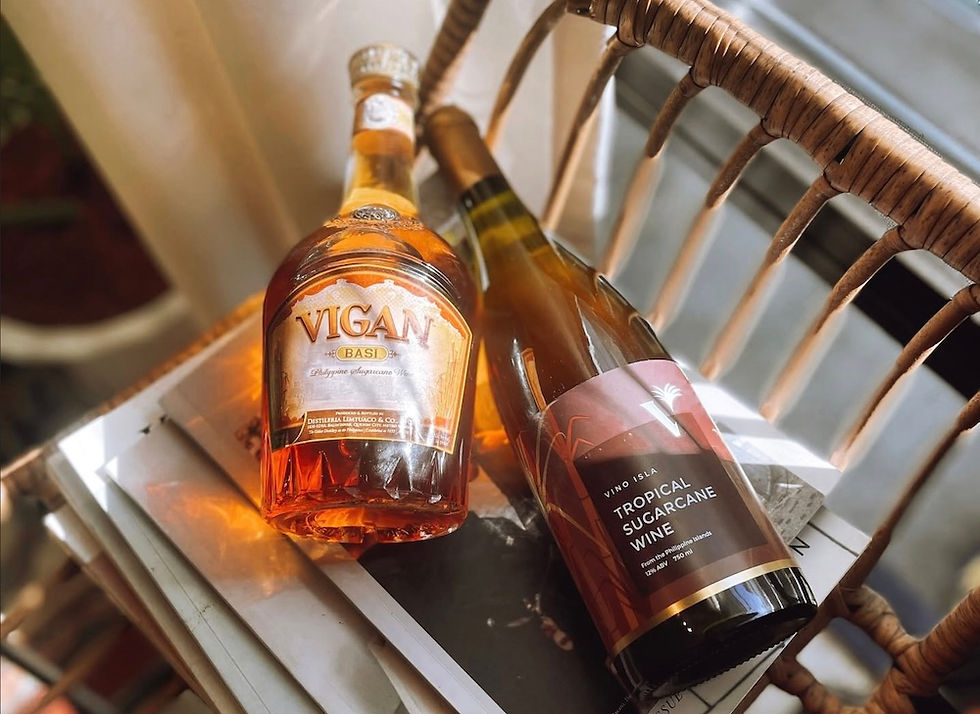
Long before rum became synonymous with sugarcane, communities in the Ilocos Region of Northern Luzon were making basi, a traditional fermented sugarcane wine with roots in precolonial Ilocano culture.
Made from boiled sugarcane juice and native fermenting agents, its production is a distinctly local affair. The sugarcane juice is boiled, cooled, and transferred into large earthenware jars called burnáy, where it ferments with locally available ingredients. Depending on the area and recipe, these can include bubod (a local yeast starter), bark, and leaves from plants such as samak and guava, as well as Java plum (duhat). The ingredients and methods vary across Ilocos, giving different producers their own approaches to the drink.
The result can range from sweet to dry, with a tangy, sometimes astringent finish that brings wine or fruit beer to mind.
Basi's history is closely tied to the region's resistance to Spanish colonial rule. In 1786, the colonial government instituted a monopoly over the production and sale of the beverage. In September 1807, Ilocano residents revolted against the restrictions, in an uprising now known as the Basi Revolt. The revolt was eventually suppressed, and its leaders were executed.
Today, basi remains a celebrated part of Ilocano heritage, and has also been featured at the National Museum of the Philippines.
Lambanog

Lambanog is distilled from tuba. While it is commonly distilled from coconut tuba, lambanog can also be made from nipa or kaong tuba. The drink is mainly produced in the provinces of Batangas, Laguna, and Quezon. This is due to coconut being the main agricultural crop in these provinces.
The lambanog drinking ritual is often called Tagayan – a way of life in Quezon that is a simple drinking session amongst friends as a ceremonial gesture of hospitality, respect, and unity.
Among these, Quezon houses some of the largest lambanog distilleries in the country, making the province the leading producer of the drink. During the Spanish rule in the Philippines, lambanog was incorrectly translated to vino de coco, or coconut wine.
To make lambanog, the sap is allowed to ferment longer than that of tuba, which is usually a day. Most would let the liquid ferment for up to three days to increase the alcohol level. After fermentation, it is filled into a traditional Filipino still for the distillation process. These pot stills are made from either hollowed-out logs or wooden planks held together by rattans, depending on the size. Two steel wok-shaped pans, known as kawa, cover the top and bottom of the still. The one on top serves as a condenser filled with cold water. A receptacle is placed below the condenser to collect cooled alcohol vapor.
Lambanog is bottled at around 40%-45% ABV and is clear in color. The flavor is described as a combination of subtle tropical fruits, slightly vegetal, with a hint of vanilla or coconut sweetness. To appeal to the younger market, most lambanog makers also produce flavored lambanog which is akin to flavored vodka (and it's often marketed as 'coconut vodka').
Laksoy

Laksoy is another type of distilled palm liquor similar to lambanog. The name specifically refers to the drink distilled from nipa tuba. Laksoy production centres around Mindanao, the Philippines' second largest island, located to the south of the archipelago. Specifically, small-scale industry has cropped up around Butuan, the regional centre of Caraga in eastern Mindanao. Despite the different name and base ingredients, laksoy shares many similarities with lambanog.
The spirit is also known by distinct names in other parts of the Philippines. In the Visayas, the drink is called dalisay, while barik is used in the Bicol region. In Southern Luzon, lambanog can refer to both coconut and nipa spirit.
Although similar, laksoy is harder to produce than (coconut) lambanog. A fruiting nipa palm needs to be located first, as the sap of the nipa palm can only be harvested from the fruiting stalk. The fruit stalk is first covered with mud for a minimum of six weeks and up to a couple of months. When the fruit is mature and ready for harvest, the dried mud is washed off, and the stalk is cut to collect the sap. This sap is allowed to be fermented for two to three days before distillation takes place.
Laksoy is distilled using the laksuyan, a traditional still made from wooden staves held together by rattan and sealed with mud. Laksuyan is a variation of the Filipino still, having a similar general setup. Almost all laksoys are single-distilled, though the drink is still quite potent, with some coming off the still at up to 50% ABV. Laksoy has a sweet, almost creamy aroma, with a subtle sweetness on the palate akin to coconut cream and brown sugar.
The Filipino Influence in Mexico
When the Spanish Galleon from Manila landed in Colima (western Mexico) in the 16th century, the Filipino sailors brought along the knowledge make and distill palm wine.
Also known as tuba in Colima, palm wine and its distillate, vino de cocos (a mistranslation by the Spanish that meant 'coconut wine'), became popular among the locals during the 16th and 17th centuries. Vino de cocos became so popular that the Spanish crown had to ban its production in the 18th century, as it threatened the sales of imported Spanish brandy.
Despite the ban, the knowledge of distillation, along with the design of Filipino stills, remained. The locals adopted the method to distill Colima's wild agave, which paved the way to early mezcal. Tuba can still be found in Colima today, while vino de cocos is slowly making a comeback.


